

For most of the last two decades, organic search followed a predictable script: research keywords, build pages, earn links, climb rankings, capture clicks. The game was hard, but at least the rules were stable.
That stability is gone. The same queries that once sent visitors to your product pages are now being answered directly by AI systems that synthesize information from dozens of sources and deliver a response without a single click changing hands. Google’s AI Overviews, ChatGPT, Perplexity, and Gemini have fundamentally changed how a growing percentage of searchers get answers. And the content those systems surface is not always the content that ranks first in traditional results.
This is why the conversation has shifted from SEO alone to SEO alongside Generative Engine Optimization, or GEO. For SaaS and ecommerce leaders, understanding what each discipline does, where they overlap, and how to resource both is no longer optional. It is the difference between showing up in the next era of search and slowly losing visibility without a clear explanation for why.
SEO vs GEO in 2026
| Category | SEO (Search Engine Optimization) | GEO (Generative Engine Optimization) |
|---|---|---|
| Core Purpose | Make content findable, trustworthy, and relevant to keyword searches | Make content usable by AI systems for answers, summaries, and citations |
| Primary Goal | Rank in search results and drive clicks | Be selected, cited, or used in AI-generated responses |
| Success Metric | Rankings + clicks (traffic) | Mentions, citations, and influence (with or without clicks) |
| How It Works | Pages are ranked based on relevance and authority | AI retrieves content, synthesizes answers, and may cite sources |
| Content Discovery | Users browse a ranked list of links | Users receive direct answers via AI interfaces |
| Key Ranking Factors | Crawling & indexing, on-page relevance, backlinks, technical health, page experience | Clarity of content, structured answers, entity consistency, verifiable claims, accessibility |
| Content Style | Long-form, comprehensive, keyword-optimized content | Modular, concise, answer-focused, structured content |
| User Queries | Keyword-driven searches, such as “best skincare for oily skin” | Conversational or question-based queries |
| Distribution Channel | Traditional SERPs, such as Google results pages | AI surfaces, such as ChatGPT, Gemini, Perplexity, and Google AI Overviews |
| Traffic Behavior | Click-driven traffic to websites | May not result in clicks; brand exposure still occurs |
| Dependency on Technical SEO | Essential for visibility | Foundational requirement; poor SEO = weak GEO performance |
| Role in Strategy | Core acquisition channel | Visibility layer built on top of SEO |
What SEO Optimizes For in 2026
Search engine optimization, at its core, is still about making your content findable, trustworthy, and relevant to keyword-driven queries. The underlying mechanics have not changed as dramatically as headlines often suggest. Crawling and indexing, on-page relevance signals, backlink authority, technical health, and page experience continue to drive organic rankings. What has changed is the SERP environment those rankings exist within.
In high-volume, transactional categories, SEO remains the most reliable lever. When someone searches “project management software for remote teams” or “best skincare for oily skin,” traditional ranked results still drive meaningful click traffic. Category pages, comparison pages, product detail pages, and high-intent blog content all benefit from disciplined keyword targeting, internal linking, and earned authority signals.
SEO also provides the foundational infrastructure that every other discovery channel depends on. A site with poor crawlability, duplicate content problems, or thin pages is not just invisible in traditional SERPs. It is also a weak candidate for AI citation, because generative systems rely on accessible, well-structured content as raw material for their answers.
The question “Is SEO being phased out?” misframes what is actually happening. SEO is not being replaced. It is being joined by a parallel optimization discipline that requires different tactics and different measurements. Teams that treat GEO as an SEO replacement will underinvest in the technical and authority signals that make GEO possible in the first place.
What GEO Optimizes For Inside Generative Engines
Generative Engine Optimization is the practice of making your content the source that AI systems select, summarize, cite, and recommend when users ask questions across conversational and assistant-driven surfaces.
The selection logic of a generative system is meaningfully different from a traditional ranking algorithm. Instead of scoring pages against a keyword and surfacing a ranked list, a generative engine retrieves candidate content, synthesizes a response, and sometimes attributes that response to a source. Your goal in GEO is not to rank first on a list. It is to be the content the model trusts enough to borrow from.
What makes content trustworthy to a generative system? Several factors matter: clarity of argument, explicit structure that matches common question formats, consistency of entity signals across the web, verifiable claims with cited evidence, and accessibility of the underlying content. A page that answers a question in a structured, direct, unambiguous way is a far stronger candidate for AI citation than a page that buries its answer in narrative prose optimized for a keyword.
The AI surfaces worth understanding include Google’s AI Overviews (which appear directly in search results), ChatGPT and Perplexity (which users treat as research tools), and Gemini (which is increasingly embedded in workspace and mobile contexts). Each has different retrieval logic, but they share a common preference: content that is organized for comprehension, not just for keyword density.
GEO is best understood as a visibility layer added on top of your existing SEO foundation, not as a replacement motion. If you have not established topical authority and technical credibility through traditional SEO, your GEO efforts will have weak inputs to work with.
The Difference Between SEO and GEO in Plain Terms
The cleanest way to articulate the distinction is through what counts as a success event.
In SEO, success is a ranking and a click. You appear in a SERP position, a searcher clicks your link, and a session begins. The distribution channel is predictable: Google returns a list, users navigate that list, traffic flows to pages.
In GEO, success is a mention, a citation, or an assist. Your content informs an AI-generated answer. The searcher may or may not click through to your site. But they have encountered your brand, your framing, and your perspective as part of their discovery process. Distribution happens across a much wider surface: AI search, chat interfaces, assistant tools embedded in apps and browsers.
The content shape required for each is also different. SEO rewards long-form depth, comprehensive coverage of a topic, and keyword variation across a well-structured page. GEO rewards answer-ready modularity: crisp definitions, structured comparisons, step-by-step explanations, and direct responses to specific questions that a user might phrase conversationally. These are not mutually exclusive content patterns, but they require intentional design to achieve both simultaneously.
GEO vs SEO vs AEO: Clearing Up the Taxonomy
Before going further, it is worth addressing the three-letter soup that has appeared in marketing discussions: GEO, SEO, and AEO.
SEO is the established discipline: optimizing for discoverability and rankings in traditional search engine results.
GEO (Generative Engine Optimization) is the emerging discipline: optimizing to be selected, summarized, cited, and trusted by AI systems that generate answers rather than return lists.
AEO (Answer Engine Optimization) refers to optimizing content to directly answer specific questions, often in formats that surface in featured snippets, knowledge panels, and voice search results. In practice, AEO execution overlaps heavily with GEO execution. Both favor structured, direct, question-responsive content. Many teams use these terms interchangeably, and the functional overlap is large enough that the distinction is more taxonomic than strategic.
“AI SEO” is an umbrella phrase used by many vendors and practitioners to mean any SEO work that accounts for AI systems, whether in answer formatting, content generation, or visibility tracking. It is less precise than GEO or AEO but widely understood.
READ: AI Terms for Beginners and Marketing Professionals
For most SaaS and ecommerce organizations, the practical question is not which term to adopt. It is which operating model to build. If your SEO team owns all search-related content optimization, you may not need separate naming. If content strategy, PR, and product marketing are all contributing to AI visibility, clearer internal taxonomy helps align ownership.
The most common question I see is “Is GEO part of SEO?” Yes, in the sense that GEO is built on the technical and authority foundations that SEO establishes. No, in the sense that GEO requires different content patterns, different measurement frameworks, and different go-to-market thinking. Treating GEO as a specialization layer within a broader search strategy is the most accurate framing for resource planning.
How Retrieval and Generation Actually Work
Understanding why GEO tactics work requires a basic model of how generative systems retrieve and use content.
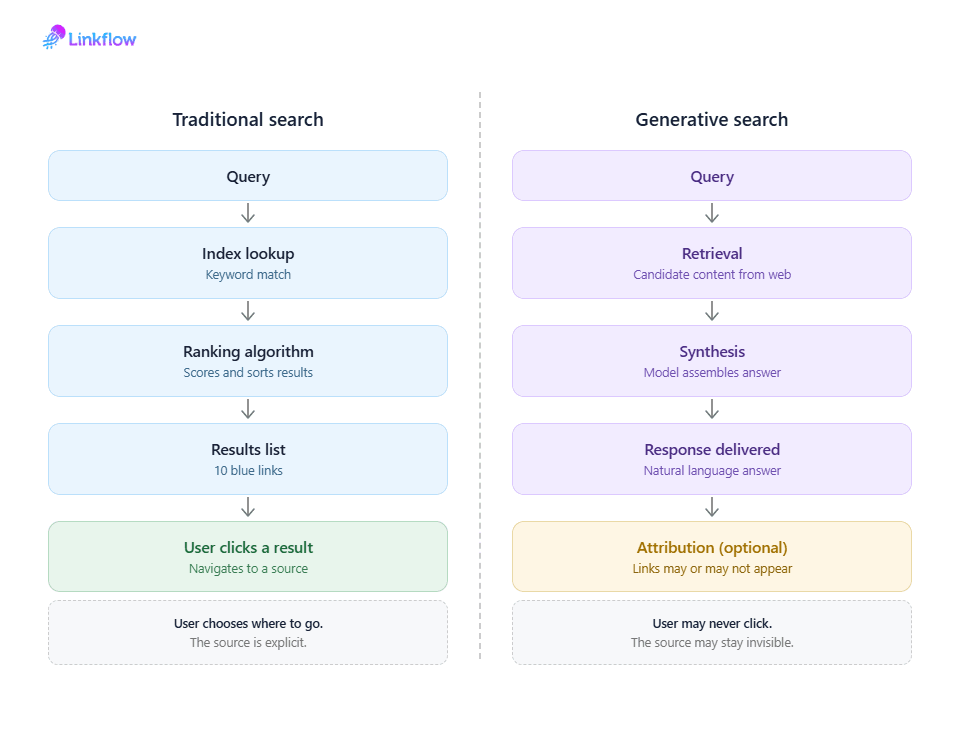 In traditional search, the path is: query, index lookup, ranking algorithm, results list, user click. The user navigates the list and chooses where to go.
In generative search, the path is meaningfully different: query, retrieval of candidate content from across the indexed web, synthesis of a response drawing on multiple sources, delivery of that response in natural language, and sometimes attribution to one or more sources. The user may never click anything. The “answer” is assembled from pieces of content that the model deems trustworthy and relevant.
This has several practical implications. First, it means that narrow, well-structured content on a specific topic can outperform broad, authoritative pages if the narrow content is more directly responsive to the question format. Second, it means that coverage breadth matters. If your content addresses related questions across a topic cluster rather than concentrating everything on a single page, you increase the surface area that generative systems can draw from. Third, it means that internal linking is not just a crawl efficiency tool. It is also a map that helps AI systems understand how your content relates to itself and to the broader topic.
Authority Signals That Work for Both SEO and GEO
One of the most practically useful observations about GEO is that the authority signals that make traditional SEO work also make GEO more effective. This means you are not starting from scratch.
Entity consistency matters in both worlds. If your brand name, product names, and author bylines are inconsistent across your own site and across the wider web, both ranking algorithms and AI models have a harder time confidently associating content with a trusted source. Audit your entity signals: how your brand is referenced in schema markup, in bylines, in press coverage, and in linked sources.
Verifiability is increasingly a differentiator. Content that cites data, links to primary sources, and makes explicit the basis for its claims is more trustworthy to both human readers and AI retrieval systems. “Show your work” is not just good editorial practice. It is a GEO signal.
Indexability and accessibility remain table stakes. Fast, crawlable, clean information architecture is the foundation that makes everything else possible. A generative system cannot use content it cannot access. Rendering issues, blocked crawl paths, and slow performance are not just SEO problems. They are GEO blockers.
READ: How to Optimize Technical SEO for AI Crawlability and Visibility
Content Patterns That Generative Engines Prefer
Beyond authority signals, certain content structures are consistently better candidates for AI citation than others.
Definition blocks work well because they give generative systems a clean, extractable unit of meaning. If you define “generative engine optimization” on your page, and that definition is clear and consistent with how the term is used across the web, you become a reliable reference point for that concept.
Comparison tables and structured tradeoffs match a common query format. Questions like “SEO vs GEO” or “which is better for SaaS brands” are comparison intents. If your content explicitly organizes criteria, differences, and decision rules in a structured format, it is easier for a generative system to synthesize into a comparison answer.
Step-by-step process content maps cleanly to “how to” queries. Numbered steps with explicit scope and constraints are more extractable than narrative descriptions of the same process.
Q&A modules and explicit FAQ sections serve dual purposes. They improve traditional SEO through structured data markup and featured snippet eligibility. They also give generative systems pre-formatted question-answer pairs that can be lifted directly into AI responses.
Executive summaries at the top of long pages are increasingly important. If a generative system is scanning your page to decide whether to use it, a clear, accurate summary of what the page covers and what conclusions it reaches makes that decision easier. Do not bury your answers.
The key principle across all of these is reducing ambiguity. AI systems handle ambiguity poorly. Content with explicit scope (“this applies to SaaS companies with product-led growth motions”), clear dates (“as of Q2 2026”), and consistent terminology is more reliably cited than content that hedges, qualifies excessively, or uses inconsistent language for the same concepts.
Rebuilding Your Content Strategy for Both Rankings and Citations
Most SaaS and ecommerce sites were built primarily for keyword-driven SEO. Adapting that content for GEO does not require starting over. It requires a structural upgrade that adds answer-ready layers to existing depth.
Map Intents the AI Way, Not Just the Keyword Way
Traditional keyword research identifies search volume and competition. AI-era intent mapping requires going further: identifying how the same question gets asked conversationally, what multi-part questions follow from an initial query, and what persona is asking.
A CMO asking about GEO vs SEO wants strategic framing and budget implications. A head of growth wants channel attribution and pipeline impact. An SEO lead wants tactical implementation and measurement. A founder wants the executive summary and the business risk.
All four might search the same keyword, but the content that serves them best is organized around their decision context, not just the keyword. Structure your pillar pages to serve multiple persona intents simultaneously, using section headers that match how each persona would phrase their specific question.
Build Cornerstone Pages as Answer Libraries
The most GEO-ready content architecture treats each major topic as a hub with supporting proof nodes. Your “GEO fundamentals” cornerstone page should contain clear definitions, structured comparisons, decision frameworks, and explicit answers to the most common questions on the topic. Supporting pages serve as focused references: KPI definitions, implementation checklists, case study evidence.
Internal linking between these pages should be treated as a comprehension map, not just a crawl optimization. When you link from your cornerstone to a supporting page, the anchor text and surrounding context should make the relationship clear: “If you are asking how to measure GEO performance, see our KPI framework.”
Add Modular Upgrades to Existing Pages
You do not need to rewrite every page. For high-traffic pages that are already performing in traditional SEO, the highest-leverage upgrades are additive:
Add a definition box at the top that provides a crisp, consistent definition of the primary concept. Add a “when to use” section that helps readers and AI systems understand the scope and appropriate application of what you are describing. Add a pitfalls section that addresses what can go wrong. Add a metrics or glossary section that defines key terms consistently. Add a short executive summary at the very top of the page that captures the main argument in three to five sentences.
These additions serve both traditional SEO (they create additional structured content that can surface in featured snippets) and GEO (they give generative systems well-formatted, extractable units of information).
Technical SEO Foundations That GEO Still Depends On
It is worth stating this plainly: GEO does not work without technical SEO. The two disciplines share a dependency stack.
Crawlability and indexing are the first requirement. If Googlebot or other crawlers cannot access and index your content reliably, it will not appear in AI retrieval pools. Clean architecture, proper canonicalization, logical sitemap structure, and correct robots.txt configuration are prerequisites, not optional enhancements.
Structured data plays a specific role in GEO that is different from its traditional SEO role. Schema markup types like FAQPage, Article, BreadcrumbList, and Product signal content structure to both search engines and AI systems. FAQPage and HowTo schema in particular function as explicit structure signals: they tell the retrieval system exactly where the questions and answers are in your content, removing ambiguity about content organization. Validate your structured data regularly. Schema errors that go undetected can quietly remove your content from rich result and AI retrieval eligibility without any visible signal in rankings.
Avoiding duplicate content traps is equally important. If multiple pages on your site address the same question with similar content, AI retrieval systems will struggle to identify which version is authoritative. This dilutes citation potential. Canonical tags and deliberate content differentiation across related pages are as important for GEO as for traditional SEO.
Content quality compliance matters for AI Overview eligibility in particular. Google’s search quality guidelines and spam policies apply to AI-generated content surfaced in search results. Scaled, low-value, or templated content that was produced without genuine expertise or editorial judgment creates eligibility risk, not just ranking risk.
KPIs for GEO vs SEO: Measuring When Clicks Are Not the Only Win
One of the most practically challenging aspects of GEO is measurement. The success events are different, the attribution is messier, and the tooling is still maturing. But that does not mean measurement is impossible. It means building a dual reporting framework.
SEO KPIs
The traditional SEO measurement set remains valid and should not be abandoned. Track rankings by intent cluster rather than individual keyword, since clusters better reflect how users actually navigate topics. Monitor organic sessions segmented by landing page type: product pages, comparison pages, informational content. Track branded versus non-branded keyword share of voice separately, since branded growth often reflects GEO lift that eventually shows up in direct and branded search.
Conversion metrics should be attributed at the landing page level: revenue per landing page, assisted conversions from organic sessions, and pipeline sourced from organic. Technical health KPIs including Core Web Vitals trends, index coverage, and crawl efficiency should be tracked on a regular cadence rather than only during site audits.
| KPI | What It Measures | How to Track | Why It Matters |
|---|---|---|---|
| Rankings by Intent Cluster | Visibility across topic groups, not just single keywords | Keyword clustering tools, rank trackers | Reflects real user search behavior and topical authority |
| Organic Sessions by Landing Page Type | Traffic segmented by page type, such as product, comparison, or informational pages | Analytics platforms, such as GA4 | Shows which content types drive traffic |
| Branded vs Non-Branded Share of Voice | Visibility for brand vs generic queries | SEO tools, such as Ahrefs or SEMrush | Indicates brand strength and potential GEO influence |
| Revenue per Landing Page | Revenue generated from specific entry pages | Analytics + CRM attribution | Connects SEO directly to business outcomes |
| Assisted Conversions (Organic) | Conversions influenced by organic traffic | Multi-touch attribution models | Captures SEO’s role beyond last-click |
| Pipeline from Organic | Leads or opportunities sourced via organic traffic | CRM + attribution tools | Critical for B2B and long sales cycles |
| Core Web Vitals Trends | Page performance, including speed and UX metrics | Google Search Console, Lighthouse | Impacts rankings and user experience |
| Index Coverage | Pages indexed vs submitted | Google Search Console | Ensures content is discoverable |
| Crawl Efficiency | How effectively search engines crawl the site | Log analysis, crawl tools | Prevents wasted crawl budget and missed pages |
GEO KPIs
The GEO measurement set requires different tools and a different mental model. The primary metric is citation or mention frequency: how often does your brand or content appear in AI-generated answers for your priority query clusters? Tools for tracking this are still developing, but manual monitoring of AI answers for target queries at regular intervals is a viable starting point for most teams.
“Answer share” tracks how much of the AI response space your content occupies across multiple queries on a topic. Brand and entity consistency scores track how reliably your brand name, product names, and key claims appear in AI responses in the form you intend.
For B2B SaaS in particular, tracking how often your brand appears in AI answers to “what tool should I use for X” or “compare X vs Y” queries is directionally useful even before perfect tooling exists. These queries are the consideration-stage interactions that drive pipeline, and appearing in them without a click is still meaningful brand exposure.
| KPI | What It Measures | How to Track | Why It Matters |
|---|---|---|---|
| Citation / Mention Frequency | How often your brand or content appears in AI answers | Manual checks, emerging GEO tools | Core indicator of AI visibility |
| Answer Share | Percentage of AI-generated answer space your content occupies | Query sampling + response analysis | Measures dominance across a topic |
| Brand/Entity Consistency Score | Accuracy and consistency of brand mentions in AI responses | Manual audits, entity tracking tools | Ensures correct positioning and messaging |
| Presence in Consideration Queries | Appearances in queries like “best tool for X” or “X vs Y” | Manual monitoring of AI tools, such as ChatGPT and Gemini | Directly tied to purchase intent and pipeline |
| AI Surface Coverage | Visibility across platforms, including ChatGPT, Perplexity, Google AI Overviews, and Gemini | Cross-platform query testing or tracking tools | Ensures broad presence where users search |
| Brand Exposure Without Clicks |
Unified Executive Reporting
The most effective reporting for leadership combines both frameworks into a single scorecard with two sections: SEO demand capture (clicks, sessions, conversions from traditional search) and GEO demand shaping (citation frequency, AI mention share, brand consistency in AI responses).
Segment your tracked queries into two classes: clickable SERP queries where ranked results still drive most traffic, and answer-first queries where generative responses dominate and clicks are rare. Reporting on both separately helps executives understand where investment is generating return in each channel without conflating two different success models.
One measurement pitfall to flag: AI response personalization means that the answer one user receives for a given query may differ from the answer another user receives. Sampling bias in manual monitoring is real. Build monitoring routines that check from multiple accounts, geographies, and query phrasings to get a more reliable picture.
Implementation Playbook: Moving from SEO to GEO Without Breaking What Works
The highest-risk mistake in implementing GEO is abandoning the SEO fundamentals that generate current revenue while chasing AI visibility gains that are harder to measure. The goal is to add GEO capabilities alongside existing SEO discipline, not in place of it.
Audit First
Before changing anything, identify which of your existing pages already perform well in AI-style queries. Search your target queries in ChatGPT, Perplexity, and Google AI Overviews. Note which of your pages are cited, which competitors are cited, and what structural features the cited content has. This audit tells you both where you are already succeeding and what content patterns to replicate.
Also audit which pages have the highest GEO opportunity based on intent. Queries that are conversational, multi-part, or comparison-oriented have higher GEO value than pure transactional queries. Map these to existing pages and flag the ones that need structural upgrades.
Prioritize High-Leverage Clusters
Do not try to optimize everything at once. Identify 10 to 20 query clusters that are tied directly to your revenue narratives. For SaaS, these are typically the queries prospects ask during consideration: comparison queries, use case queries, “how does X work” queries. For ecommerce, these include category-level comparison queries, ingredient or specification questions, and “best X for Y situation” queries.
Within each cluster, identify the single canonical page that should be your primary citation candidate. This is the page you will invest in most heavily for GEO upgrades.
Roll Out Iteratively, Protect Top Performers
Make structural upgrades to existing pages rather than full rewrites wherever possible. Full rewrites risk disrupting the authority and link signals that are driving current SEO performance. Adding a definition block, an FAQ section, a comparison table, or an executive summary to an existing page is lower risk than replacing the page.
For your highest-traffic organic pages, be especially conservative. The upside of GEO citation does not justify breaking pages that are generating pipeline through traditional search. Test structural additions on mid-tier pages first, observe impact on both traditional rankings and AI citation frequency, and use what you learn to inform upgrades on your most valuable pages.
What Not to Do
Do not over-optimize for AI snippets at the expense of actual depth and expertise. Generative systems are increasingly good at detecting thin, snippet-optimized content that lacks genuine information value. The content that performs best for GEO is content that is genuinely useful to a human reader, not content that has been formatted to look answer-ready while saying very little.
Do not abandon link building and technical authority work. The brand trust and topical authority signals that come from earned links, consistent publishing, and technical credibility are the inputs that make AI systems trust your content in the first place. These are not legacy SEO activities. They are GEO enablers.
Operating Model and Governance
GEO adds cross-functional complexity that pure SEO did not require. Because AI visibility depends on entity consistency across owned content, earned media, social presence, and partner coverage, the team that manages brand communications and PR is now a GEO stakeholder alongside the SEO and content teams.
Editorial standards need to be explicitly defined and enforced. What is the canonical definition of each core concept your brand owns? How are key product names and features described consistently across content, support documentation, and marketing materials? Who reviews content for accuracy before publication? When are pages refreshed to maintain factual currency?
Update cadence should distinguish between two types of content. “Fast refresh” content, such as pages that answer AI-style queries about rapidly evolving topics, needs monitoring and updates on a monthly or quarterly basis to remain accurate and citation-worthy. “Deep refresh” content, such as SEO pillar pages built for long-term authority, requires less frequent but more thorough revision.
Cross-functional ownership should be explicit. SEO owns technical health, schema, internal linking, and traditional performance metrics. Content owns information architecture, answer-ready formatting, and editorial standards. PR and communications own entity consistency across external coverage and brand mentions. Product marketing owns use case framing and competitive positioning in AI answers. Engineering enables performance, crawlability, and structured data implementation.
Which Is Better, SEO or GEO: Decision Criteria by Business Model
The honest answer is that “better” is the wrong frame. The relevant questions are which to prioritize given your current situation and how to allocate resources across both.
If you sell high-intent products or services with clear transactional queries (SaaS with a short sales cycle, ecommerce with category search demand), traditional SEO is your baseline revenue driver. GEO accelerates consideration and trust-building, particularly for complex purchase decisions where buyers research in AI tools before they ever visit your site. Build SEO as your primary capture channel and use GEO to shape demand upstream.
If you sell complex, considered solutions (enterprise SaaS, professional services, high-consideration ecommerce), GEO may be your most important awareness and trust channel. Buyers in these categories spend significant time in AI tools before they ever search a branded query. Being cited in AI answers during the research phase influences which vendors make their short list. Here, GEO deserves resource investment proportional to that pipeline influence.
If you are a content publisher or media brand, the stakes are highest and the complexity is greatest. AI Overviews are already reducing click traffic to informational content in some categories. Diversifying to direct traffic, newsletters, and owned channels while simultaneously optimizing for AI citation is a necessary hedge. Pure reliance on traditional organic traffic is a concentration risk worth addressing now.
READ: Top 10 Generative Engine Optimization (GEO) Agencies of 2025
Budgeting and Resourcing
GEO does not require a completely new team, but it does require new skills or deliberate skill development. The capabilities you need that may be underrepresented on a traditional SEO team include information architecture expertise (structuring content for comprehension, not just keyword density), editorial quality assurance (consistent definitions, verified claims, source attribution), subject matter expert access (the genuine expertise that makes content citation-worthy), and AI surface monitoring (tracking citation frequency across generative search tools).
Will GEO Replace SEO?
No. And teams that bet on replacement over convergence will find themselves poorly positioned on both fronts.
What is actually happening is that the search ecosystem is expanding. Traditional keyword-driven search continues to serve high-intent, transactional queries efficiently. Generative search is handling an increasing share of research, comparison, and discovery queries. Both surfaces matter. Both require investment.
The strategic hedge is multi-surface visibility: ensuring your brand and content are credible and accessible across both traditional SERP rankings and AI retrieval systems. Organizations that build what might be called a “hybrid moat” are compounding authority across both dimensions simultaneously. Brand trust earned through editorial rigor and earned coverage improves traditional rankings and AI citation frequency at the same time. Topical depth built through a well-structured content cluster serves both keyword-driven searchers and generative retrieval systems.
Think of content as a product, not a campaign output. Well-maintained, structured, accurate content that is kept current and organized for comprehension is a durable asset in both SEO and GEO. Content that was produced for a single keyword sprint and never revisited is increasingly a liability: it signals to AI systems that the source is not reliably maintained.
READ: AI Strategy Roadmap: Build a Practical AI Roadmap for Growth
The Bottom Line
Search is not broken. It is expanding into territory that rewards a different set of capabilities alongside the ones that have always mattered. Technical rigor, editorial quality, topical authority, and genuine expertise are not relics of traditional SEO. They are the inputs that make GEO possible.
The teams that will win are not the ones that abandon SEO for GEO or treat them as competing priorities. They are the ones that build the infrastructure for both: technically sound, well-structured, expert-driven content that earns rankings in traditional search and citations in generative AI answers simultaneously.
That is not a reinvention of your search strategy. It is an upgrade of it.
Need help getting started? Learn about our GEO services and how we can help you identify your biggest opportunities for growing your brand’s AI citations.